Liberated from the arthouse cliches of cinema, Bertrand Bonello is a rare kind of director. Our host Hugo Emmerzael spoke with Bertrand about his daring approach to filmmaking, and why his films focus on translating our collective social anxieties. Find out how influences from Lynch to Jarmusch all unconsciously seep into this French director’s work, as well as what it’s like working with Lea Seydoux and her unique acting approach for his latest film The Beast.
Book tickets to The Beast at LAB111.
Baloji is a prolific francophone rapper, known for his visually striking and poetic style. So his turn to filmmaking only seemed like a natural evolution of his talents. Speaking with the Belgian-Congolese director, Elliot discusses Baloji’s feature debut Augure, unpacking this incantatory drama about identity and grief. Inspired by the weight of his own name, which took on the loaded meaning of “evil sorcerer” in colonial times, Baloji explains the clashes of culture, mixing Western & African folklore.
Raised by the do-it-yourself mentality of hip-hop, Elliot explores with Baloji his role in not only writing and directing but also costume design and soundtracks that all contributed to this visually stunning ensemble story. Rooted in magical realism, find out how Baloji invites the audience to experience rather than to watch.
Book tickets to Augure at LAB111 here.
Do AI portrayals in film predict a future of robotic overlords or simply offer a chance to innovate cinema?
Artificial Intelligence in cinema goes way back. Spanning from Fritz Lang’s 1927 Metropolis and robot Maria, to the iconic Hal in 2001: A Space Odyssey, our tech obsession runs deep in film. But why is it all so dystopian?
What now seems to be a serious technological shift, we discuss how A.I. could impact cinema and what film depictions of sentient machines might tell us of what’s to come.
Come watch 2001: A Space Odyssey with us as part of our first ever Celebrating Cinema Film Club – book your tickets here.
(click on the links for tickets to screenings at LAB111)


Amidst the abundance of parodies, memes, and impersonations, there exists an undeniable uniqueness to the American actor Nicolas Cage. It’s easy to dismiss him as an over-the-top actor, yet beneath the surface lies a talent that positions him among the greatest actors of our time. With an unconventional, almost avant-garde approach to acting that defies the conventions of naturalism prevalent in most mainstream cinema, Cage’s body of work invites a deeper exploration.
On this episode of Celebrating Cinema we open the Cage and analyze the eclectic performances, the larger than life persona, and how in recent years Cage has become more and more aware of his oddball status.
Book tickets to Nicolas Uncaged @ LAB111
(click on the links for tickets to screenings at LAB111)
After a steamy winter featuring Emerald Fennell’s Saltburn, the internet was sent into a frenzy over – a fairly mediocre – erotic murder drama, that featured copious amounts of sex. Naturally, Laura Gommans, friend of the podcast, was left questioning what happened to all the sex scenes in cinema today.
The 90s marked an era of iconic scenes of intimacy in films like Wild Things, Cruel Intentions, Eyes Wide Shut, Indecent Proposal, Risky Business, Basic Instinct, it was a horny time. In contrast studios like A24 are currently showcasing some truly jarring sex scenes. How did we get here? And why are blockbuster movies like Avatar deleting their sex scenes?
Intrigued by these cinematic shifts, seasoned entertainment editor Laura joins the discussion to unpack the significance of sex in film while getting to the bottom of just exactly why desire on screen has become so contentious.
(click on the links for tickets to screenings at LAB111)
“Obviously Doctor, you’ve never been a 13-year-old girl.” (Cecilia, Virgin Suicides)
Affectionately known as cinema’s favorite ‘Nepo Baby’, Sofia Coppola has come a long way from her initial appearance in her father’s iconic trilogy, The Godfather. Now standing as a unique auteur truly shaping the narrative of the ‘girl era.’
With pitch-perfect precision, Coppola translates the fabric of girlhood, revealing the heartaches and struggles of her characters as they journey into adulthood. These dreamy personas are stuck in a patriarchal society, always yearning for something more, a taste of authenticity and freedom beyond their current lives.
Joined by producer and Coppola-fanatic, Sacha Gertsik shares both tales from her interview with Coppola at the Venice Film Festival last year, and her rich archive of Coppola-soaked memories, discussing how this American director continues to elevate the essence of girl-fabrication.
Book tickets for Lost in Coppola @ LAB111
(click on the links for tickets to screenings at LAB111)
“I would like to make a film to tell children “it’s good to be alive”.” ― Hayao Miyazaki
It’s hard to find someone who doesn’t love Hayao Miyazaki’s films. Regardless of age, there is something profound to be gained from watching any of this Japanese animator’s masterpieces. In this celebration of Miyazaki and the wonders he has created, we delve deep into the nostalgic yet fictional universe of Studio Ghibli. For many of us, our earliest film memories are of the Totoro, Kiki the Witch, Princess Mononoke, or Spirited Away. But how have his films shaped our worldview? We explore Miyazaki’s process and discuss why his animations remain just as relevant today.
(click on the links for tickets to screenings at LAB111)
“Hope is political. If you have hope then you have confidence you can change things”
After 60 years of filmmaking, British filmmaker & icon Ken Loach offers what may well be his most urgent message yet, calling for solidarity and the power that hope can instil in his latest film The Old Oak (2023).
Speaking with our host Elliot, Ken reveals how he never runs out of stories to tell when it comes to championing the everyday people. He says, these are the very stories and people that can pave the way for change.
At 87 years old, we hear the films of the 1960s Ken still returns to and how he still carries the spirit of filmmaking during these revolutionary times with him today.
If there was ever a time to be reminded of hope and solidarity it is now.
(click on the links for tickets to screenings at LAB111)
Movies have always been a way to understand the world around us, and so, confronted with the brutal horrors of both Hamas’s attacks on October 7th and Israel’s disproportionate slaughtering of thousands of innocent Palestinian civilians, we question if cinema can try to make sense of such atrocities.
For this episode of Celebrating Cinema, we focus on Gillo Pontecorvo’s seminal classic The Battle of Algiers, a brutally candid exposé of the French colonial mindset, which recounts a similar bloody struggle for the liberation of the Algerian people in the 1950s. Ultimately, this film both humanises and complicates the reality of violence between the oppressor and the oppressed.
As we discuss public oppression, organised resistance, how violence begets violence, as well as the media’s power in ‘selling’ a colonial occupation and the consequences for the civilian people caught in the middle of all this. But most importantly we focus on how a film like The Battle Of Algiers can offer hope for freedom in these tragic times.
(click on the links for tickets to screenings at LAB111)
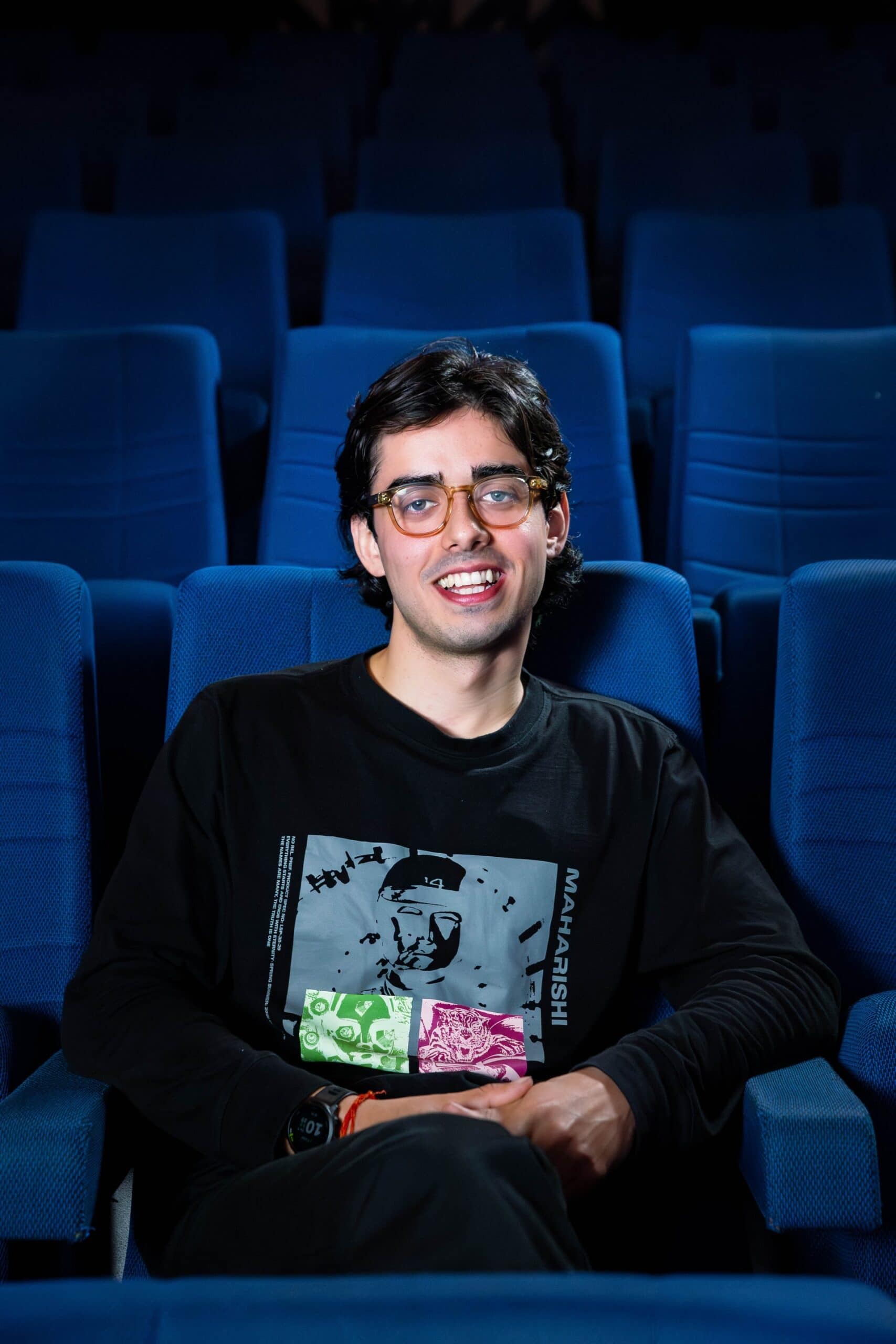
For this edition of Future Frames, you can hear from our rising filmmakers who we’ll be screening at Volk’s Hotel Sunday Shorts on 10th Dec. You can buy tickets here.
Bram Ruiter is a filmmaker of a different kind. He has a unique ability to extract the poetry of the mundane, experimenting as much as he can within the realms of the moving-image. Not tied to traditional narrative structures, Bram’s obsessed with the inner-mechanics of filmmaking, taking film elements apart and seeing how they work – often breaking the ‘rules’ to do so.
But strangely it’s the mechanics of big blockbusters he finds beauty in, citing Steven Spielberg and Tony Scott as heavy inspirations. But how does this influence a non-narrative filmmaker who’s much more experimental with their films? Bram shares how he’s led by the practical process of filmmaking in creating his films.
From the use of digital, analogue, phones & video games to the scratching and experiments with film emulsions – Bram takes us down a rabbit-hole of a whole other realm of filmmaking.
You can watch his tender film Here & Elsewhere at Volks Sunday Shorts or visit his website to discover more.
(click on the links for tickets to screenings at LAB111)